

The process of producing phosphoric acid from sulfuric acid is mainly achieved through a wet process.
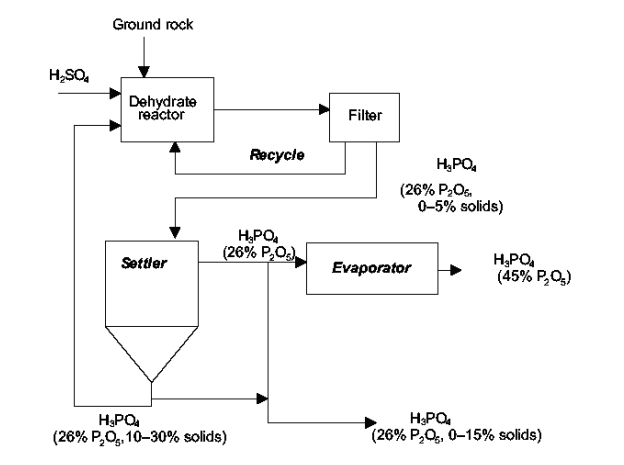
Firstly, phosphate rock reacts chemically with concentrated sulfuric acid to form phosphoric acid and gypsum. After the reaction is completed, gypsum impurities are separated using filtration technology to obtain a solution containing phosphoric acid. Finally, the concentration of phosphoric acid is increased through evaporation or concentration equipment to bring it up to standards for industrial use.
Introduction to Phosphoric Acid
Phosphoric Acid, with the chemical formula H3PO4, is an inorganic compound. As a strong acid, it presents colorless and odorless liquid at room temperature. Phosphoric acid is widely used in industrial production, mainly covering agricultural fertilizer, food processing, pharmaceutical manufacturing,detergent industries,etc.
The Three Production Processes of Phosphoric Acid
There are three different manufacturing techniques for producing phosphoric acid: wet process, thermal process, and dry kiln process.
The wet process typically uses sulfuric acid to produce phosphoric acid, while the thermal and dry kiln processes employ different methods. Each of these processes has its own characteristics in terms of raw materials and procedures, making them suitable for various industry needs.
Wet Process: This is a method of producing phosphoric acid by directly reacting phosphate rock with sulfuric acid. Among the global companies that produce phosphoric acid, more than 90% of them use the wet process because from the perspective of corporate efficiency, this method has lower costs and higher output.
However, phosphoric acid produced by the wet method contains more impurities, so it is usually used in fertilizer manufacturing and other industries, is not suitable for food-grade or pharmaceutical-grade products.
Thermal Process: This technique produces high-purity phosphoric acid by directly burning high-purity phosphorus or phosphorus compounds. Whereas, due to its high production costs and energy consumption, thermal methods are usually only used in fields with strict requirements on the purity of phosphoric acid, such as the food, pharmaceutical and electronic industries.
Dry Kiln Process
This is an innovative technology that generates phosphoric acid through the reaction of phosphate rock and coke. Compared with the wet method, the energy consumption of the dry kiln method is reduced by more than 40%, so it is more energy-saving. According to its production principle, the dry kiln method is suitable for large-scale production. However, the product may contain more impurities, the number of companies using this process is not large,Above all, the wet method is widely used by manufacturing companies as a cost-effective production method, while the thermal method and dry kiln method are selected to meet the special needs of specific industries.It is usually only used into those industry that do not require high purity of phosphoric acid.
Wet Process - Production of Phosphoric Acid Using Sulfuric Acid
An introduction to the entire process of producing phosphoric acid by the wet process—including the chemical reaction between sulfuric acid and phosphate rock, the separation and filtration of the mixtures, and the concentration of phosphoric acid—will help you understand more clearly how sulfuric acid is used to produce phosphoric acid.
1.Chemical reaction
Phosphate rock (mainly apatite, Ca₅(PO₄)₃F) reacts with concentrated sulfuric acid (H₂SO₄) to release phosphoric acid (H₃PO₄) and by-product gypsum (CaSO₄·2H₂O)
The chemical equation is:
Ca5(PO4)3F+5H2SO4+10H2O→5CaSO4⋅2H2O+3H3PO4+HF
2.separation and filtration
In the actual reaction process, the resulting mixture contains phosphoric acid and solid impurities such as gypsum. Therefore, it is usually necessary to use filtration or centrifugation to separate solid gypsum from liquid phosphoric acid.The separated phosphoric acid usually also contains some impurities and incompletely reacted sulfuric acid, which can be purified through further chemical treatment or distillation process. Such steps help improve the purity of phosphoric acid, making it more suitable for subsequent applications.
3.concentration
The concentration of phosphoric acid produced is usually low, so its concentration needs to be increased through evaporation or concentration steps to meet different industrial needs.
The Importance of Phosphoric Acid
As a very important chemical raw material, phosphoric acid is widely used in many industries such as agriculture, food processing, medicine and detergent production. Among its production methods, the wet technique is widely adopted due to its cost-effectiveness and adaptability, and is particularly suitable for the production of fertilizers.
With technological advancement and increased environmental awareness, the production techniques of phosphoric acid are expected to be further optimized. Therefore, mastering various phosphoric acid production technologies is extremely important to improve product quality and meet market demand.
FAQ
1. How to produce different concentrations of phosphoric acid?In the wet phosphoric acid production process, different phosphoric acid concentrations can be achieved by adjusting multiple factors in the purification stage. Commonly used techniques include controlling the initial concentration, temperature, and evaporation process of phosphoric acid.
--Phosphoric acid concentration: A higher initial phosphoric acid concentration helps achieve higher concentration one after purification.
--Temperature control: Since the reaction is exothermic in nature, higher temperatures can increase the reaction rate and extraction efficiency. However, temperatures need to be carefully managed to prevent product degradation.
--Extraction time: Longer extraction time usually means higher purity and concentration of phosphoric acid.
--Solvent concentration: Using a higher concentration extraction solvent can separate impurities more effectively, thereby increasing the concentration and purity of the final product.
--Comparison: During the solvent extraction process, the ratio of the aqueous phase to the organic phase will also affect the extracted phosphoric acid concentration.
These adjustments are key factors in optimizing the quality and efficiency of phosphoric acid production.
2. What percentage of sulfuric acid is needed to produce phosphoric acid?
In production practice, the sulfuric acid with concentration of 93%-98% is usually used, which can generate a higher concentration of phosphoric acid, thereby reducing the energy consumption of the evaporation process.
It should be pointed out that factors such as temperature, pressure and impurities in actual production will affect the efficiency of the reaction and the quality of the final phosphoric acid. Therefore, in order to optimize the production process, it may be necessary to appropriately adjust the proportion of sulfuric acid used.